of 4K–3rd graders in the Valders Area School District scored lower on the 2024–2025 early literacy screener than 75% of the students in the national comparison group: 136 of 331 children.
The Valders Area School District includes St. Nazianz, a small village in Manitowoc County. It is home to a sprayer plant that the Miller family built over five generations, and that CNH Industrial, the parent of Case IH and New Holland, has owned since 2014.
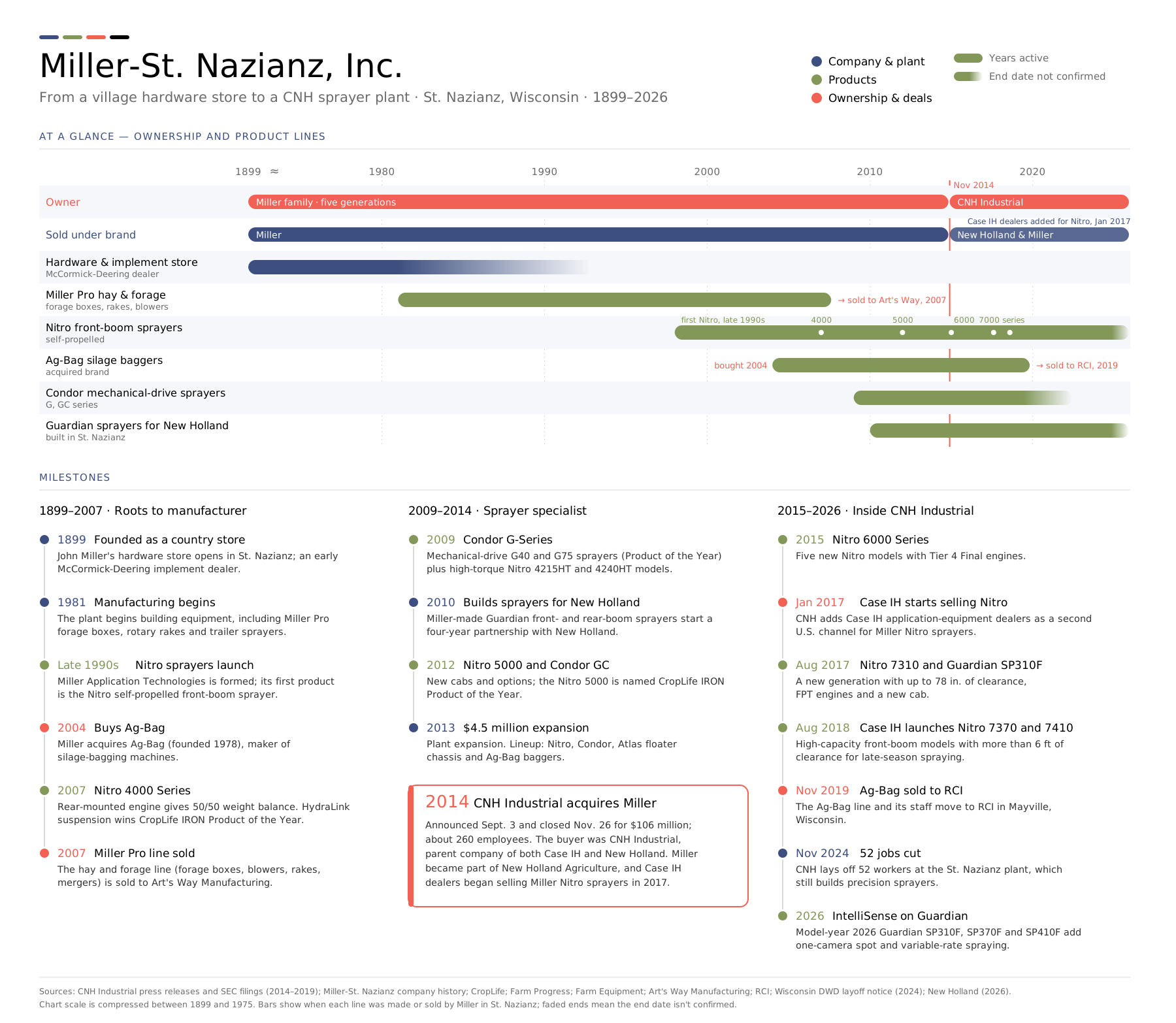
In short: a village hardware store opened in 1899. Miller moved into manufacturing in the 1980s and launched its Nitro self-propelled front-boom sprayer in the late 1990s. In November 2014, CNH Industrial bought the business for $106 million. The plant now builds Miller Nitro sprayers, sold by Case IH dealers since 2017, and Guardian sprayers for New Holland. In November 2024, CNH cut 52 jobs at the plant, more than a quarter of its 191 workers.
Read the timeline as text
- 1899John Miller’s hardware store opens; an early McCormick-Deering dealer.
- 1980sManufacturing begins: Miller Pro forage boxes, rotary rakes and trailer sprayers.
- Late 1990sFirst Nitro self-propelled front-boom sprayer.
- 2004Buys Ag-Bag silage baggers.
- 2007Nitro 4000 Series; Miller Pro forage line sold to Art’s Way.
- 2009Condor G-Series mechanical-drive sprayers.
- 2010Starts building Guardian sprayers for New Holland.
- 2012Nitro 5000 and Condor GC.
- 2014CNH Industrial buys Miller, closing November 26 for $106 million.
- 2015Nitro 6000 Series.
- 2017Case IH dealers start selling Nitro; Nitro 7310 and Guardian SP310F.
- 2019Ag-Bag sold to RCI in Mayville.
- 202452 jobs cut in November.
- 2026Guardian adds IntelliSense spot and variable-rate spraying.
Two ways to spray a field


The Guardian is a big machine. New Holland lists models up to 412 horsepower, tanks as large as 1,600 gallons and booms as wide as 135 feet. For model year 2026 it adds IntelliSense: one camera on the cab looks 50 feet ahead across the whole boom, so the sprayer can change its rate on the go or spray only the weeds it sees. There are no subscriptions or per-acre fees.
Ryan Nell, who farms in Beaver Dam, Wisconsin, took the other road. His post describes a two-pass fungicide plan, the second pass by drone over corn too tall for most ground rigs. The drone is a Vector AGR HD580. His goal:
“Keep the plant alive and green as long as possible.”
The software matters as much as the airframe. Nell flies with software from Ceres Air [link], a US drone company:
“We are running ceres air software. American software!”
From the field
Beaver Dam is about 60 miles southwest of St. Nazianz: this is the plant’s own neighborhood. Nell sprays only his own acres, and his posts give a rare, honest look at what a spray drone can do, and what can go wrong.
“Covered 525 acres yesterday. 3-400 is not hard. Field size is key.”
“28ft at 30mph at 2.5 gal rate”
“Trees, powerlines and wind is your enemy.”
“I also believe the farmer owned and operated drone is the future. Better timing and the grower controls the parameters”
The math behind 525 acres
- ≈ 100 acres an hour while flying: a 28-foot swath at 30 mph.
- ≈ 7.4 acres per load: 18.5 gallons at 2.5 gallons an acre.
- ≈ 70 refills to cover 525 acres, about one every 4 to 5 minutes of spraying.
Our arithmetic from Nell’s settings. Turns, battery swaps, refills and wind make real days slower.
The price tag
Spray drone
Vector AGR HD580
$36,999
ready-to-spray kit, list price
$27,500 for the drone alone
- Tank
- 18.5 gallons (70 L)
- Coverage
- 50–70 acres an hour at 2 gallons an acre
- Swath
- up to 33.7 feet
- Kit
- drone, remote, charger, three batteries
Ground rig
New Holland Guardian SP310F
$855,665
one dealer’s asking price, new 2026 model
other listings vary widely
- Tank
- 1,200 gallons (Guardian line: up to 1,600)
- Power
- 310 horsepower
- Boom
- 120 feet (line: up to 135)
- Built
- St. Nazianz, Wisconsin
Prices are dealer listings from 2026: the HD580 kit at Zuercher’s (Iowa); the SP310F at KanEquip (Kansas). They are not quotes. The two machines do different amounts of work, so the fair test is cost per acre treated well and on time, counting batteries or fuel, labor, refills, weather and repairs.
The drone costs about 4% as much. It also carries about 1.5% as much liquid, so it refills often. That is why many farms use drones for some passes, not all of them.
Spray drones are no longer a novelty. US spray drones treated about 16.4 million acres in 2025, up from 3.7 million in 2023. Most of them were made in China: more than 90% of US spray drone sales in 2024. On December 22, 2025, the FCC put new foreign-made drones on its Covered List, which blocks new models from sale here. US spray drone sales fell 59% in 2025, and the share made in America rose to about 24%.
What does this mean for a plant like St. Nazianz?
- Drones don’t replace big sprayers, yet. Nell’s drone carries 18.5 gallons; a Guardian carries up to 1,600. On wide, flat acres the ground rig still wins.
- Drones win where ground rigs struggle: tall corn, wet fields, hills, odd corners and no wheel tracks. Trees, power lines and wind are their limits.
- The buyer may change. Big sprayers are often bought by large farms and custom applicators. If more growers spray their own acres by drone, as Nell expects, some of those purchases could shift.
- Value is moving from steel to sensors and software. IntelliSense is that shift inside the Guardian. On the drone side, American software is now a selling point: in July 2026 the FCC proposed barring new imports and sales of foreign-made spray drones already on its Covered List.
- The work changes. The 2024 layoff list named assemblers, welders, painters and material handlers. New products also need people who can read technical manuals, write code and fix electronics.
- Cameras
- Chips
- Software
- Batteries
- Electric motors
- Autonomy
- Networks
“Why is the US so far behind?”

On October 17, 2026, Peter Menet of Menet Aero led an FAA Safety Team seminar, “Drone Operations for the Novice and Safety Professional.” Menet Aero is a veteran-operated Wisconsin company in Genoa City that builds tethered drones. His question was simple: why is the US so far behind?
The numbers explain the question. Ukraine says it built more than 4 million drones in 2025 and aims for more than 7 million in 2026. Bloomberg estimated that the US makes about 100,000 military drones a year.
Washington has noticed. In July 2025 the Pentagon said small drones should be treated as “consumables,” like ammunition, and set a goal of leading in small drones by the end of 2027.
1945 vs. 2025
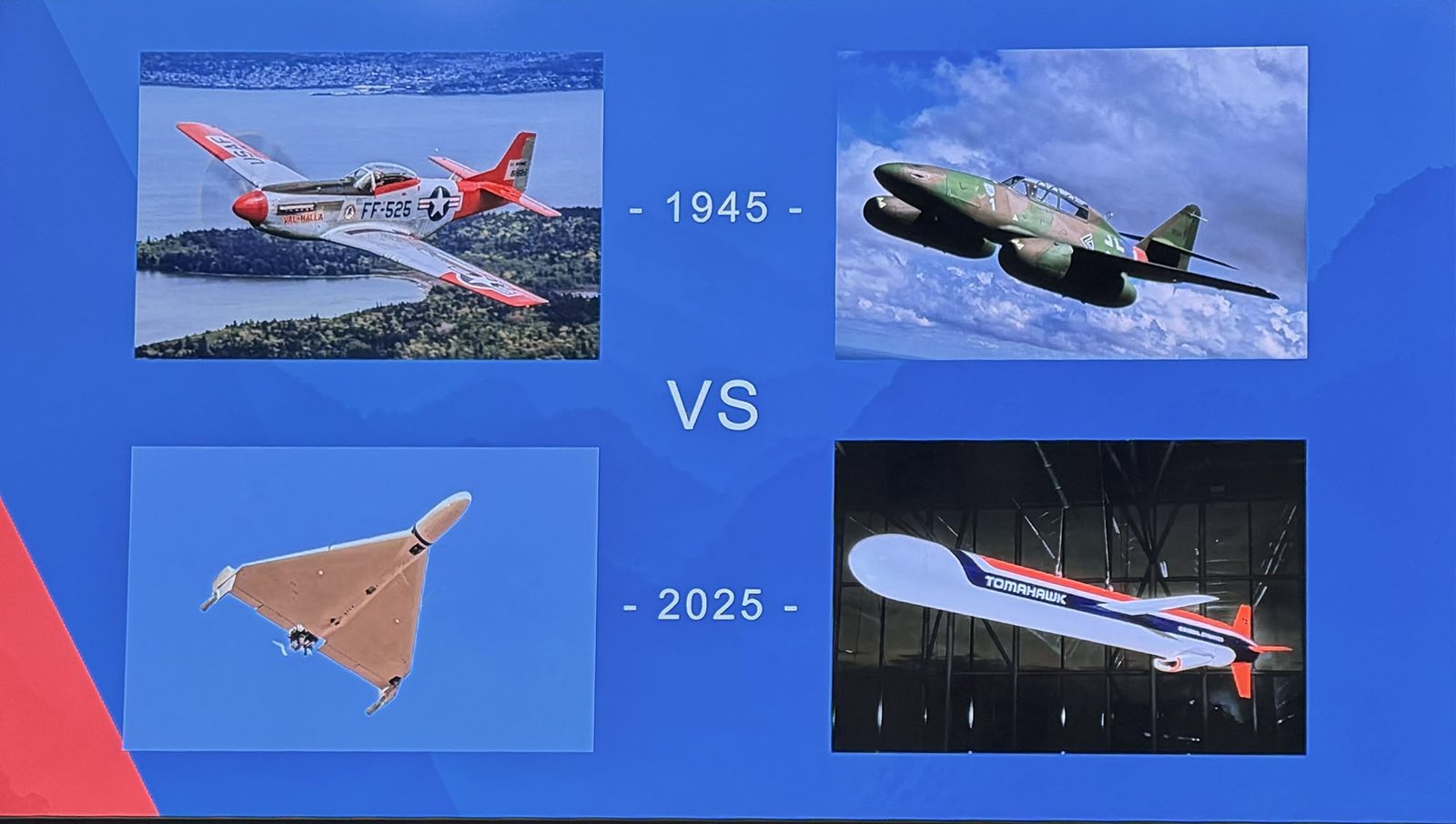
The slide puts two pairs side by side. On the left, a good-enough machine built in huge numbers. On the right, a more advanced machine built in small numbers. In 1945 the US was on the left. Today it is on the right.
1945
P-51 Mustang
United States · piston fighter
- Built
- 15,000+ (sources range up to 16,766)
- Cost
- ≈ $954,000 in 2026 dollars ($50,985 in 1945)
- To build one
- ≈ 2,000–3,300 labor hours by 1944–45, down from about 12,000 at the start
- 1940Britain orders it in May; prototype airframe done in 102 days; first flight in late October
- 1942Enters service
- 1944Long-range escorts reach Berlin
- 1945Wartime production winds down
Messerschmitt Me 262
Germany · first operational jet fighter
- Built
- 1,443; only about 300 saw combat
- Cost
- RM 87,400 for the airframe alone (no engines, guns or radios). No reliable 2026-dollar figure: wartime currency and forced labor make a conversion misleading.
- To build one
- ≈ 6,400 labor hours per airframe; engines lasted only about 10–25 hours
- 1938Design work begins at Messerschmitt
- 1941First flight, April 18, on a piston engine
- 1942First flight on jet power, July 18
- 1944Enters service in April
2025
Shahed-136 / Geran-2
Iran, built in Russia · one-way attack drone
- Built
- Tens of thousands; exact total unknown. Russia launched about 55,000 Shahed-type drones and decoys at Ukraine in 2025 alone.
- Cost
- ≈ $20,000–$50,000 (2025–26 estimates); upgraded versions up to about $80,000
- To build one
- Days, mostly from commercial parts; Russia made about 170 a day by May 2025, decoys included
- 2021In service with Iran
- 2022First used against Ukraine in September; Russia licenses production in November
- 2023Russian production ramps up at Alabuga, Tatarstan
- 2026Jet-powered versions; the US fields its own copy, LUCAS, at about $35,000
Tomahawk
United States · cruise missile
- Built
- ≈ 9,000 since 1983; about 60 a year before 2026
- Cost
- ≈ $3.64 million (Block V, FY2026 dollars, US Navy)
- To build one
- 18–24 months from order to finished missile; one watchdog estimate is 47 months from contract to delivery
- 1972Development begins
- 1983Production begins
- 1991First combat use
- 2026More than 1,000 fired in the Iran war by late April; a $22.9 billion contract aims for 1,000+ a year
The P-51 is restated with the September 2026 consumer price index (336.940 vs. 18.0 in 1945). Labor hours, days and months measure different things: work per unit, factory speed and order-to-delivery time. Shahed costs are outside estimates; Russia and Iran do not publish them. Labor hours for WWII aircraft vary by source and by year.
How the Pentagon buys things
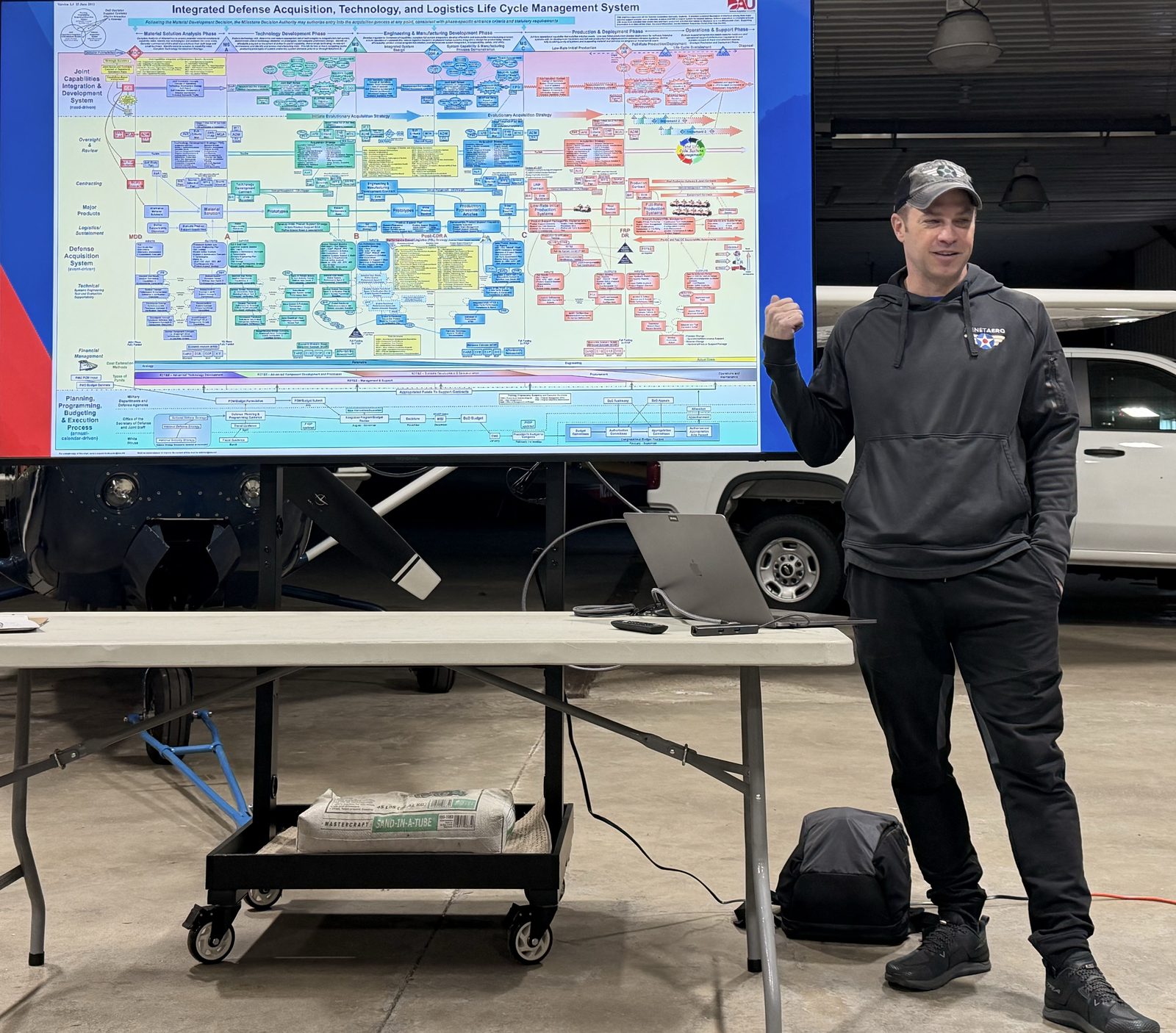
The chart behind Menet is the Defense Acquisition University’s “Integrated Defense Acquisition, Technology, and Logistics Life Cycle Management System.” It shows three systems that must move together:
- Requirements, driven by need: what does the military want?
- Acquisition, driven by events: reviews and Milestones A, B and C before full production.
- Budget, driven by the calendar: Congress funds it one year at a time.
The result is slow. In July 2026 the Government Accountability Office found that major weapon programs now take more than 12 years, on average, to deliver a capability. The Mustang prototype took 102 days.
In November 2025, the Pentagon renamed this process the “Warfighting Acquisition System” and said speed is now its organizing principle. Whether the new name changes the chart is the test.
“A very difficult discussion”
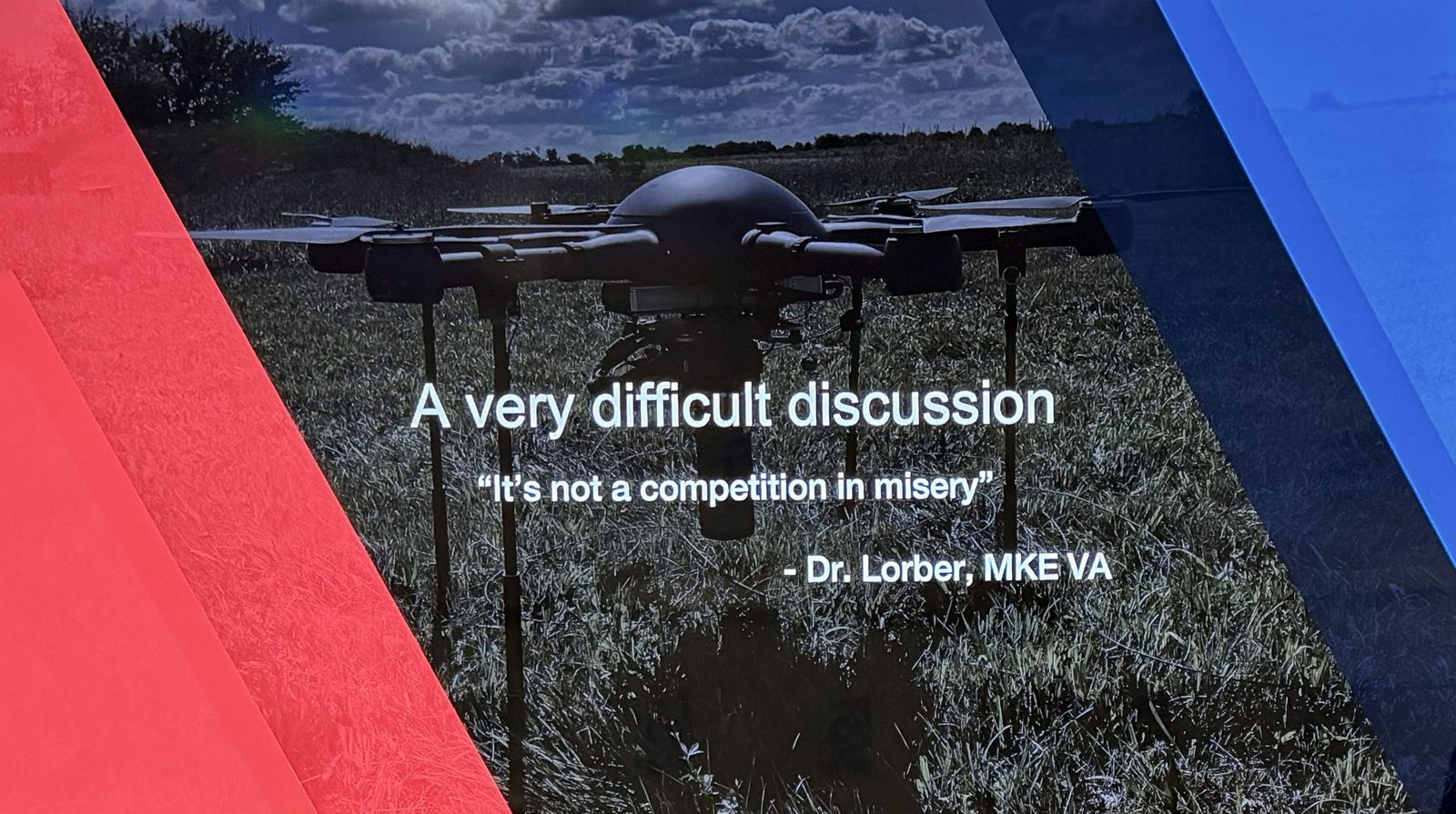
Menet closed with that line. It fits this page, too. It is not a contest over who is worse off: Valders or Wisconsin, Wisconsin or the nation, the US or Ukraine. The point is to see the gap clearly and act.
Here is what it takes to build products like drones, smart sprayers and the machines that make them:
- ReadingManuals, specs, safety rules, FAA and EPA labels
- MathRates, angles, flow, cost per acre
- SoftwareCode, settings, updates, data
- ElectronicsSensors, batteries, motors, wiring
- Problem solvingFind the fault, test the fix
- SpeedLearn fast as the tools change
Every one of these starts with reading. A worker who can’t read a work order, a wiring diagram or a chemical label can’t build, fly or fix today’s machines.
Are we equipping our children to succeed?
41.1% of 4K–3rd graders in the Valders Area School District, 136 of 331 children, scored below the 25th percentile on the 2024–2025 early literacy screener. The Wisconsin average: 37%. Below the 25th percentile is an early warning that a child needs help, not a diagnosis or a verdict on the child’s future. These children will be about 20 to 25 years old in 2040, when today’s drones will look as dated as a P-51.
Explore Valders Area and every Wisconsin district. Most of the spray drones flying over Wisconsin fields were made in China; compare PISA reading in B-S-J-Z (China) and the United States.
St. Nazianz has reinvented itself before: from a store to a factory, from forage boxes to front-boom sprayers. The next change is already here. It will be built by people who can read, do math and keep learning.
Essential literacy and math skills are the place to begin, now.